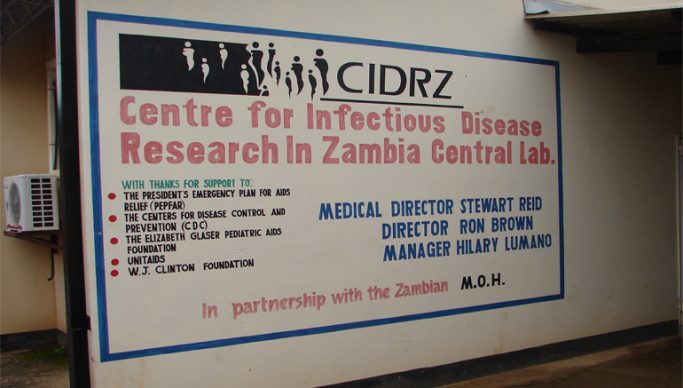
West CIDRZ cuts contract jobs citing financial constraints
By Staff Reporter
THE Centre for Infectious Diseases Research in Zambia (CIDRZ) in the Western Province has prematurely terminated year-long employment contracts for over a 100 HIV treatment support workers it recently engaged in six districts citing over-recruitment and financial constraints.
And network of people living positively in Mongu district says the backlog of unpaid HIV/AIDS-drug supply services to Brazilian pharmaceutical companies by the government will make life unbearable for the over 45,000 Zambians on Anti-Retroviral Therapy.
According to some of the treatment support workers that had their job contracts terminated by CIRDZ, they were strategically employed as HIV treatment management front-runners in Mongu, Kalabo, Lukulu, Senanga, Sesheke and Kaoma.
“The major role the treatment support workers handled was treatment advocacy, community sensitisation campaigns for Voluntary Medical Male Circumcision, as well as the contribution to the management of the ART services in the health centres,” they pointed out. “The other mandate the treatment support workers were part of was contributing to the testing services done through door-to-door in the health centre catchment areas, follow up ART defaulters and general community mobilisation for health services.”
Although the workers were engaged at different times, the vacuum they have left in the organisation is huge especially for the Western Province whose prevalence rate stands at 16 per cent according to the Zambia Population Based HIV Impact Assessment Report for 2016.
“Some of the reasons advanced for the termination of the contracts were over-recruitment and financial matters. Although the organisation is expected to start running various projects under new funding, the chances to bring back all the laid off workers still remains a puzzle. The importance of the role the workers played cannot be overemphasized taking into consideration the inadequate staffing levels in the health centres which are operating far below their required establishments,” said one of those affected.
And reacting to President Edgar Lungu’s recent pronouncement of mandatory HIV testing, Network of Zambian People Living with HIV/AIDS Mongu Chapter coordinator, Cleopatra Muketoi said Zambia was not ready for compulsory HIV testing.
She said this was due to the challenges the country was already struggling to cope with in a bid to provide treatment services to those living positively with HIV.
“With the current figure at over 45, 000 clients on the ART national register, with a back log of unpaid supply services to Brazilian pharmaceutical companies, for example, carried forward from previous years, will make life even more complex for the clients who depend on ART,” Muketoi explained. “Among the most obvious reasons which will make the suggested mandatory testing not bear the expected results are infrastructure, financial and human resource barriers which still raise concerns to human rights groups and make the implementation of such a program a nightmare.”
Muketoi outlined the other impediments to mandatory HIV testing as the increased treatment defaulter rates among people living positively, self-stigma, leading to what has been termed as ‘treatment holiday’.
“Another critical factor to take into consideration is the revelation made by the World Health Organisation, which indicates that making HIV mandatory to a population may seriously result in the violation of the rules and regulation of the so many treaties and conventions Zambia is a state party to,” she said.